Vinetaro Drops Official Website › Choosing a circulation supplement
Choosing a circulation supplementChoosing A Circulation Supplement: Seven Checks
Seven questions, answerable in a couple of minutes from any label or listing. They are ordered so that the ones which settle the matter come first.
The last section scores the bottle this website sells against all seven. It passes two, half-passes two and fails three, and the table says which.
Written to work on any product in this category, including the ones this desk does not sell.
Check one: does the label name every ingredient?
First, because nothing below it can be answered without it.
This is first because it decides whether the other six can be answered at all. A product that names its ingredients can be researched, cross-checked against a prescription, screened for an allergen and compared with a published trial. A product that does not can be none of those things, by anybody.
Naming means naming to the species where it matters, not gesturing at a category. Cinnamon is two different plants with two very different coumarin loads. Nettle root and nettle leaf are separate pharmacopoeial materials. Ginseng covers several species with different chemistry. A label that says cinnamon has told you less than it appears to.
The variant to watch for is the proprietary blend: a list of names under a single combined weight. That satisfies the letter of a naming requirement while withholding the one number that would let anyone evaluate it, and a twenty-two-component blend at 200 mg total is arithmetic a buyer can do for themselves.
Check two: is there an amount beside each name?
A name tells you what. Only an amount tells you how much.
A name without an amount is a flavour of a claim rather than a dose of anything. The evidence guide beside this one prints what the published work in this category actually used: 900 mg a day of a standardised hawthorn extract, 26 g of wild blueberry powder supplying 302 mg of anthocyanins, 300 mg of Gymnema twice a day. Those numbers exist to be compared against something.
The comparison is the whole value of an amount on a label. A product carrying 50 mg of something the trials ran at 900 mg is not necessarily useless, but a reader deserves to know that is the position rather than discovering it later. Most of the disappointment in this category lives in that gap.
Watch the unit as well as the number. A percentage in front of a weight changes what the weight means: 100 mg of an extract standardised to 5% of a marker compound contains 5 mg of the marker, and trials are usually run on the marker.
Check three: what is the daily dose, and who set it?
The number that turns a bottle into a number of weeks.
Every product has an intended routine and it should be on the package, because it is the number that turns a bottle into a duration. One capsule twice a day out of sixty capsules is a month. Two drops a day out of sixty millilitres is a much longer and much vaguer proposition, and both figures should be findable in a few seconds.
Liquids raise a specific version of this question. A drop is not a unit of measurement. Its size varies with the pipette, with the viscosity of the liquid and with the angle of the hand, and the usual working figure of around 0.05 ml is a convention rather than a specification. A liquid that states a millilitre dose has told you considerably more than one that states a number of drops.
Check also where the instruction is printed. An instruction on the bottle is part of the label. An instruction on a marketing graphic is a marketing decision that can change between campaigns without anything on the package changing with it.
Check four: how does the amount compare with the published work?
Put the label's number and the trial's number in the same row.
This is the check that takes the longest and pays back the most. Take each named ingredient with its amount, find what the trials on it used, and put the two figures side by side. The companion guide does that work for twelve botanicals so that most readers will not have to start from nothing.
Three outcomes are possible and all three are informative. The product matches the trial dose, which is rare and worth paying for. It sits well below, which is common and means the label is borrowing a reputation rather than reproducing a result. Or the comparison cannot be made, which is what checks one and two were for.
A fourth possibility deserves naming because it flatters no one: the trials themselves may be thin. Three poorly reported trials with an author's verdict of unproven is a different situation from fourteen pooled trials with a cautious conclusion, and a reader should weigh the quality of the evidence as well as the size of the gap.
Check five: what does the claim actually say?
The permitted verbs, and how far the marketing travels past them.
Supplement claims are written in a constrained language and reading it accurately takes about a minute of practice. Supports, promotes, helps maintain and aids are the permitted verbs for a structure and function claim, which describes an effect on the body's normal working. Treats, cures, prevents and reverses describe a disease and are not available to a supplement.
So a product saying supports healthy circulation is saying the strongest thing it is allowed to say. That is worth knowing in both directions: the restrained wording is not modesty, and the absence of a stronger claim is not evidence of a weaker product.
The asterisk beside each such phrase points at the statement that these claims have not been evaluated by the Food and Drug Administration. It is required and it is not a warning about that particular product. What is worth noticing is how far the marketing around the bottle travels beyond the phrases on it, because that distance is a deliberate choice by somebody.
Check six: what can be verified about how it was made?
The question is never whether there is a seal.
Seals are the easiest part of a package to produce and the hardest to check, so the question is never whether a seal is present. It is whether the seal carries an identifier that leads somewhere.
A Good Manufacturing Practice claim means something when it names the facility and the body that audited it. A facility registration claim means something when it carries the registration number, and it is an administrative filing even then rather than an approval of the product. A third-party testing claim means something when a certificate with a laboratory's name, a date and a method sits behind it.
The test to apply is simple and it takes seconds: could you take anything printed on this seal to a third party and get an answer? If not, the seal is a design element. That is not proof of anything wrong, and it is not proof of anything at all, which is the point.
Check seven: what happens if you want your money back?
Ask before you pay, not after you want to stop.
The last check is commercial and it is the one most often skipped. Before paying, find the return window in days, find out who pays return postage, and find out whether an authorisation is needed before posting anything.
A guarantee that names no number of days is not a guarantee, it is a sentiment. Where a marketplace listing sets the window, screenshot the listing at the moment you buy: that screenshot records what you were actually offered, which no later page can do for you.
Two other details are worth two seconds each. Return postage is usually the buyer's, which changes the economics of returning five bottles. And a refund involves two waits rather than one, because the seller processes the return and then a bank moves the money, and only the first of those is within anyone's control.
The seven checks applied to Vinetaro Drops
The same seven rules, applied to the product this website sells.
This website sells Vinetaro Drops, and a checklist whose own product passes seven from seven would be a checklist written backwards. Here is the scored table, using the same rules as the sections above.
| Check | Result | Why |
|---|---|---|
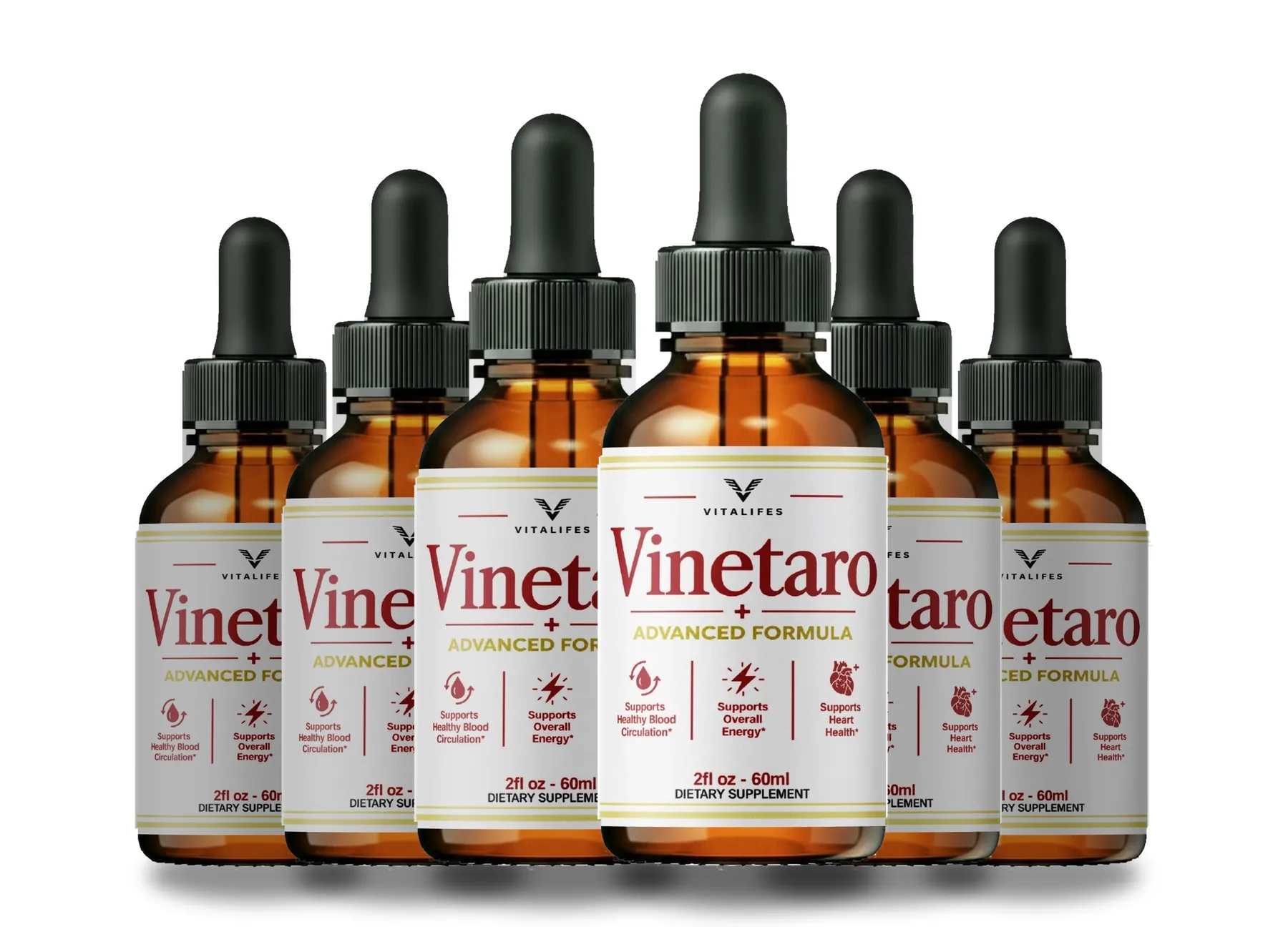
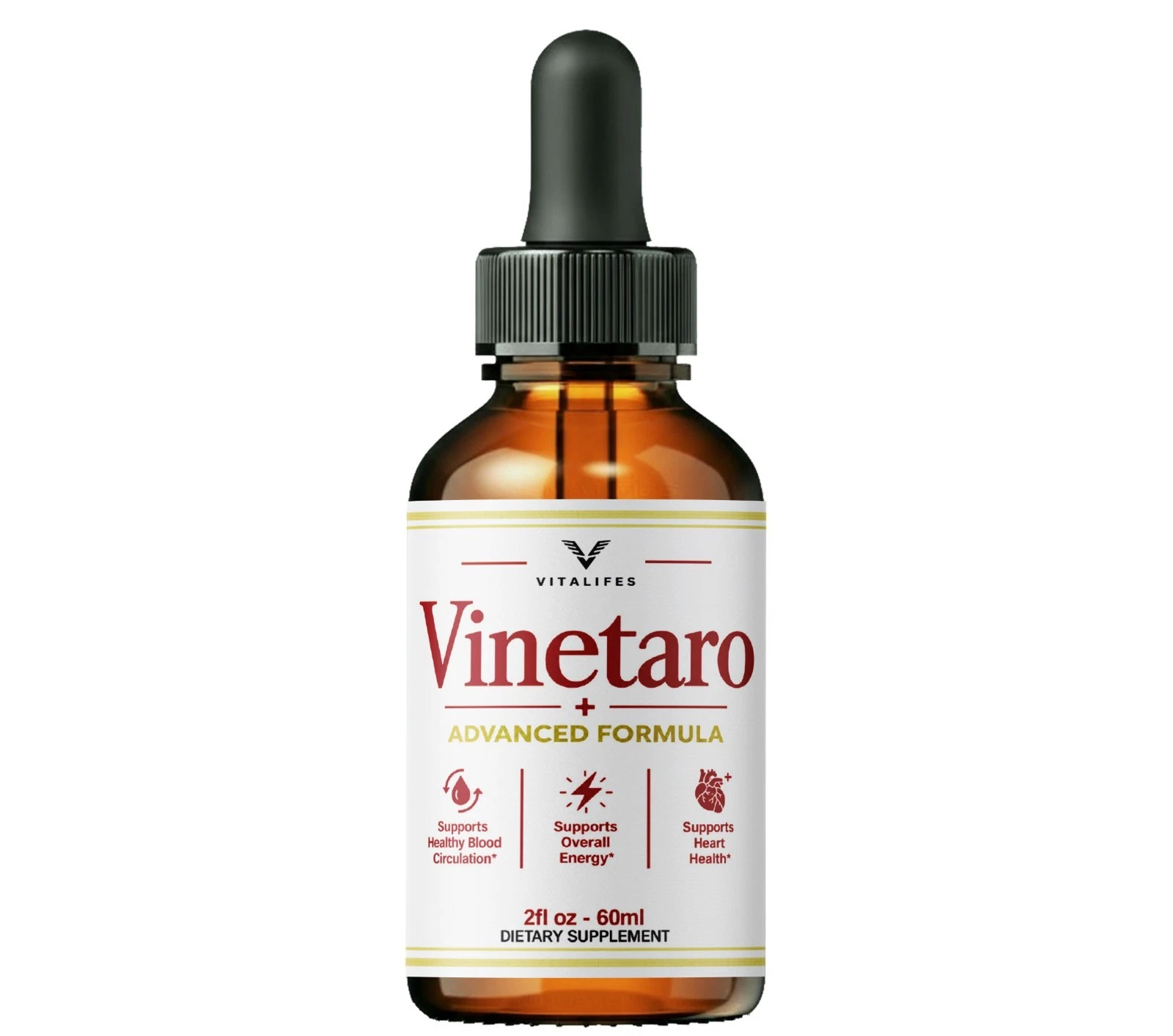
| 1. Every ingredient named | Fail | The front of the label carries a maker line, the product name, ADVANCED FORMULA, three support phrases and the volume. The marketing panels photograph six plants and name none of them |
| 2. An amount beside each name | Fail | There is no panel to carry amounts, and check one has to pass before this one can |
| 3. A stated daily dose | Half pass | Two drops daily after a meal, from the seller’s own graphic rather than from the bottle. A drop is also a convention rather than a unit |
| 4. Amount against the published work | Fail | The comparison cannot be made. That is the reason this site prints what published results cost instead, and leaves the label’s column as it is |
| 5. The claim says what the marketing says | Half pass | The three label phrases are standard and accurate. Six further claims appear on the marketing panels and on no bottle, and this site lists them and uses none |
| 6. Something verifiable about manufacture | Half pass | Four seals with no registrant number, no certifying body and no certificate identifier, plus lot VIN-26/TH-7868 and certificate reference VIN-7868-26-TH, which do tie a complaint to a run |
| 7. A stated refund route | Pass | The roundel says money back, the window is set at the checkout, and the refund route is six documented steps through the order desk |
One pass, three half passes and three fails. A reader who runs the same seven checks on any competing bottle will get a comparable table, which is the point of having them.
The three fails all have the same root, and it is worth stating once rather than three times: this bottle declares no ingredient. Checks one, two and four are a single failure counted three times, because each one depends on the one before it.
What the product does well sits in the last three rows. The routine is simple and stated. The label’s own claims are modest and accurate, even though the marketing around it goes further. And the refund route is documented end to end, which a surprising number of products in this category cannot say.
Whether that balance is worth your money is not a question a retailer should answer for you. What this desk can do is show its working, which is what the table above is.
Where Vinetaro scores
- A stated daily routine, printed by the seller and easy to keep
- Label claims that are modest, standard and accurate
- A lot number and a certificate reference tying a complaint to a run
- A documented six-step refund route through a desk that answers
- Amber glass, which is the right container for a botanical liquid
Where Vinetaro does not
- No ingredient is named anywhere on the label
- No amount exists for anything, so no comparison with published work is possible
- The dosing instruction is on a marketing graphic rather than on the bottle
- Four seals carrying nothing a reader could look up
- Six marketing claims that no bottle supports
Sources behind the seven checks
Seven papers, each one standing behind one of the checks above.
- Izzo AA, Hoon-Kim S, Radhakrishnan R, et al. A Critical Approach to Evaluating Clinical Efficacy, Adverse Events and Drug Interactions of Herbal Remedies. Phytother Res. 2016;30(5):691-700. PMID 26887532. https://pubmed.ncbi.nlm.nih.gov/26887532/
- Tucker J, Fischer T, Upjohn L, et al. Unapproved Pharmaceutical Ingredients Included in Dietary Supplements Associated With US Food and Drug Administration Warnings. JAMA Netw Open. 2018;1(6):e183337. PMID 30646238. https://pubmed.ncbi.nlm.nih.gov/30646238/
- Abraham K, Wöhrlin F, Lindtner O, et al. Toxicology and risk assessment of coumarin: focus on human data. Mol Nutr Food Res. 2010;54(2):228-39. PMID 20024932. https://pubmed.ncbi.nlm.nih.gov/20024932/
- Holubarsch CJ, Colucci WS, Meinertz T, et al. The efficacy and safety of Crataegus extract WS 1442 in patients with heart failure: the SPICE trial. Eur J Heart Fail. 2008;10(12):1255-63. PMID 19019730. https://pubmed.ncbi.nlm.nih.gov/19019730/
- Wood E, Hein S, Mesnage R, et al. Wild blueberry (poly)phenols can improve vascular function and cognitive performance in healthy older individuals: a double-blind randomized controlled trial. Am J Clin Nutr. 2023;117(6):1306-1319. PMID 36972800. https://pubmed.ncbi.nlm.nih.gov/36972800/
- Mangione CM, Barry MJ, Nicholson WK, et al. Vitamin, Mineral, and Multivitamin Supplementation to Prevent Cardiovascular Disease and Cancer: US Preventive Services Task Force Recommendation Statement. JAMA. 2022;327(23):2326-2333. PMID 35727271. https://pubmed.ncbi.nlm.nih.gov/35727271/
- Agbabiaka TB, Wider B, Watson LK, et al. Concurrent Use of Prescription Drugs and Herbal Medicinal Products in Older Adults: A Systematic Review. Drugs Aging. 2017;34(12):891-905. PMID 29196903. https://pubmed.ncbi.nlm.nih.gov/29196903/
Order Vinetaro Drops with the scorecard in front of you
One pass, three half passes and three fails, published by the desk that sells it. The money-back satisfaction seal is on the pack if the balance turns out wrong for you.
Price shown at the seller’s checkout · money-back satisfaction seal on the pack
Order Vinetaro Drops On The Official WebsiteTwo drops daily after a meal · 2 fl oz / 60 ml · lot VIN-26/TH-7868