Vinetaro Drops Official Website › Ingredients
IngredientsVinetaro Drops Ingredients
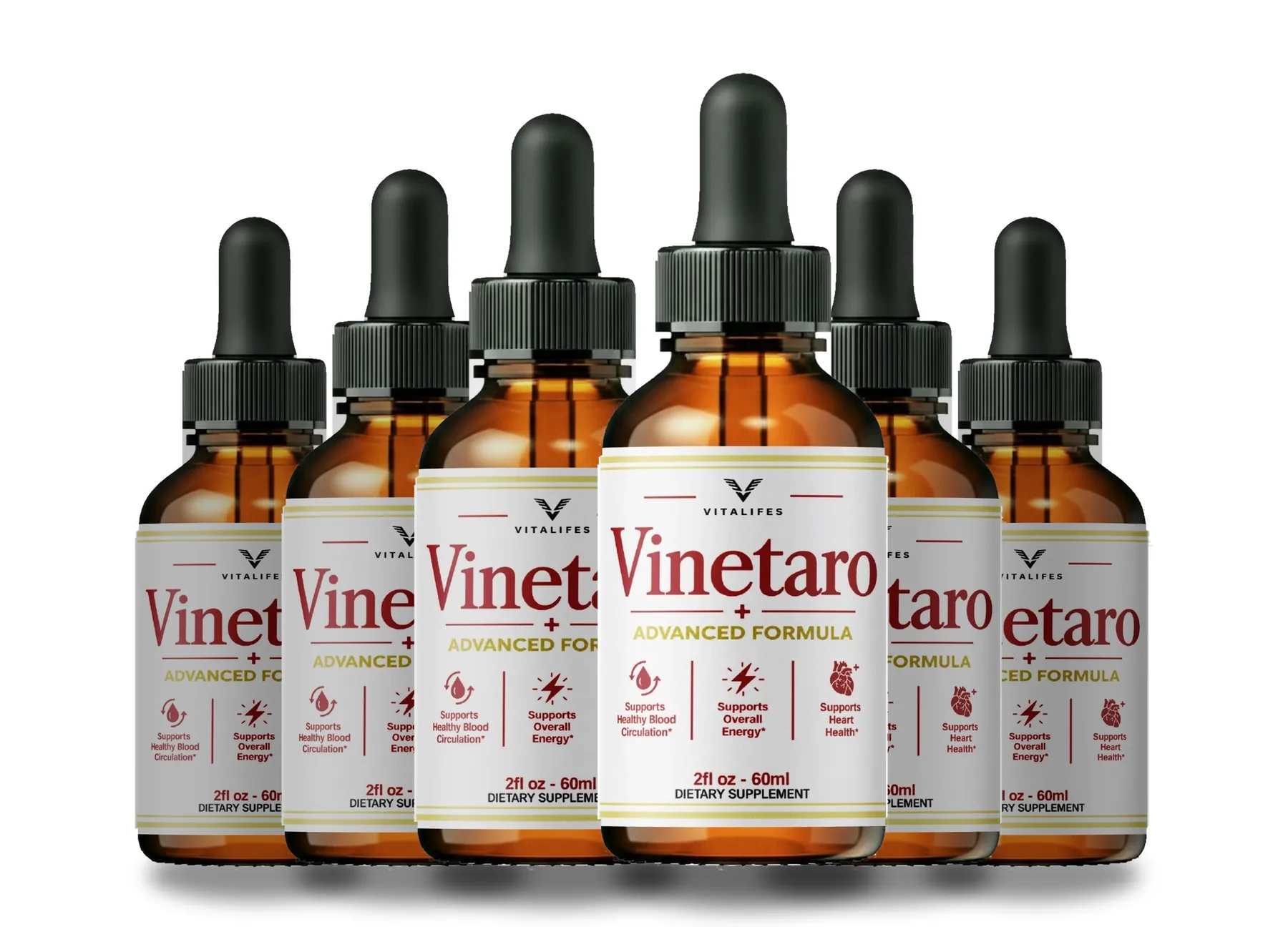
The Vinetaro Drops bottle names no ingredient anywhere on its printed surface. The front carries the maker's logo, the product name, ADVANCED FORMULA, three support phrases and the line 2fl oz - 60ml.
The seller's red panel photographs six plants around the bottle and labels none of them. This page identifies what can be identified, and sets each plant beside the amount its own research weighed.
What the bottle prints, what the photograph shows, and what a full panel would have had to say.
What does the Vinetaro Drops label print where an ingredient list would be?
Eight lines, one face, and no second panel behind them.
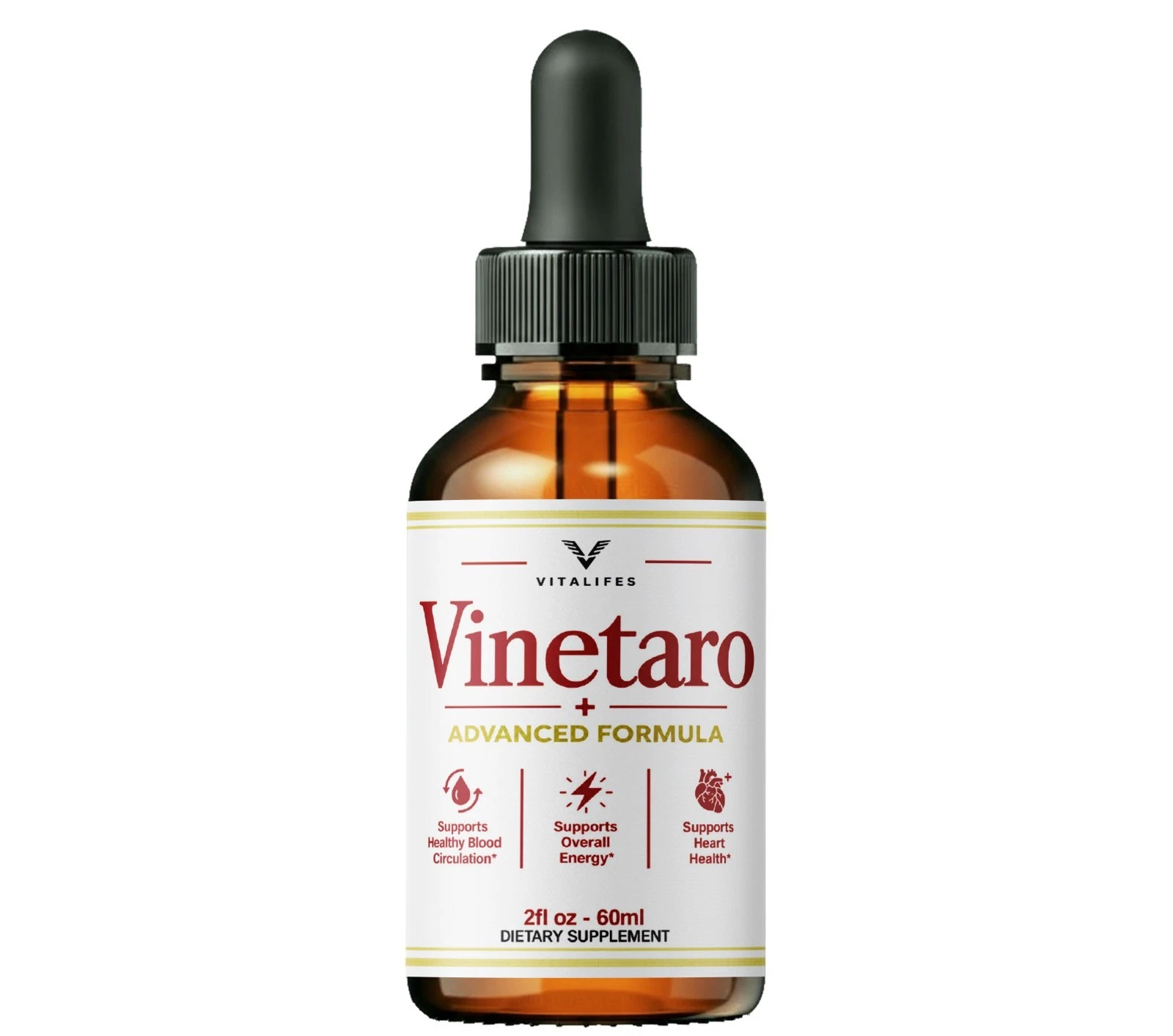
Eight lines of type, and that is the entire printed surface a buyer receives. The maker's name sits at the top, the product name below it, a marketing line under that, then three support phrases, then the volume and the words DIETARY SUPPLEMENT along the lower band.
Every bottle photograph the seller publishes is taken from the front. Twelve images ship with this product and each one shows the same face of the same amber glass. Turn the bottle over in any of them and the shot ends.
That is worth saying at the top of an ingredients page rather than at the bottom, because it changes what the rest of this page can honestly be. It cannot be a transcription. It can be an identification of what the seller photographs, set against what those plants have had to weigh in published work, and that is what follows.
| Line on the bottle | What it is |
|---|---|
| VITALIFES | the maker's logo, set above the product name |
| Vinetaro | the product name, with a plus sign beneath it |
| ADVANCED FORMULA | a marketing line, not a description of anything |
| Supports Healthy Blood Circulation | the first of three starred support phrases |
| Supports Overall Energy | the second |
| Supports Heart Health | the third |
| 2fl oz - 60ml | the volume, on the lower band |
| DIETARY SUPPLEMENT | the statement of identity every such product must carry |
Read off the label artwork in the seller's own pack, in the order the bottle prints it.
Which plants does the Vinetaro Drops photograph actually show?
Six items sit around the bottle on the red marketing panel. Three can be named on sight, three cannot, and the chip on each card carries what the published work on that plant weighed rather than anything attributed to this bottle.
Cinnamon bark
Cinnamomum speciesTrials: grams a day, for weeksRolled quills of inner bark lie across the front of the seller's red panel and are the easiest thing in the shot to name. Cinnamon is the most-supplemented spice in the metabolic category and it has the deepest human record of anything pictured here. A 2024 dose-response meta-analysis pooling twenty-four randomised trials reported fasting glucose and HbA1c falling while fasting insulin did not move.
Two details matter more than the headline. The work was done in people already diagnosed with type 2 diabetes, which is a different population from a healthy adult buying drops. And cassia cinnamon carries coumarin, for which a European risk assessment set a tolerable daily intake of 0.1 mg per kilogram of body weight: about 7 mg a day for a 70 kg adult. Species and quantity both decide whether that ceiling is anywhere near, and a photograph settles neither.
Blueberries
Vaccinium speciesTrial: 26 g powder, 302 mg anthocyaninsA small heap of dark berries sits at the front left of the panel. Blueberry is the one plant in this photograph whose circulation evidence comes with a number a reader can hold on to. A double-blind trial in healthy older adults gave 26 g of freeze-dried wild blueberry powder a day, supplying 302 mg of anthocyanins, and measured vascular function against placebo.
Twenty-six grams is a heaped tablespoon of powder. A six-month trial in people with metabolic syndrome ran at 75 g and 150 g of freeze-dried equivalent a day, which is half a cup and a full cup of blueberries. Those are food quantities. They are the scale at which the berry in this photograph has produced measured change, and they are not a scale any dropper reaches.
Ginkgo leaves
Ginkgo bilobaTrials: standardised leaf extractThe fan-shaped leaves at the upper right of the panel are unmistakable. Ginkgo is the classical circulation botanical and its main human record sits in intermittent claudication, the cramping calf pain that comes on with walking. A Cochrane review of fourteen trials in 739 people found no reliable benefit on walking distance. An earlier meta-analysis had been more favourable, and the direction of travel between the two is the usual one as trials get larger and better controlled.
Ginkgo also carries the one interaction on this page that is worth naming out loud. A 2025 analysis of ginkgo drug interactions looked at bleeding risk and coagulation profiles, and ginkgo appears in systematic reviews of warfarin interactions as well. Anyone on an anticoagulant has a specific reason to raise this product with the prescriber, and the side effects page sets that out in full.
A small red berry
Not identifiable from the photographNo trial can be attached to itThree or four glossy red berries sit at the lower right. They are the one item in the shot this desk will not put a name to. Hawthorn berry, schisandra, rose hip, goji and several ornamental fruits all read the same way at that resolution, and each of them takes the page in a different direction.
Hawthorn would be the interesting answer, because hawthorn is the botanical with the strongest heart-failure record in this whole category and it is dealt with on the how it works page. Naming it here on the strength of a photograph would be the exact move this page exists to avoid. A berry in a picture is a berry in a picture.
A green leafy herb
Not identifiable from the photographNo trial can be attached to itLoose green leaves are arranged behind the bottle. Mint, basil, centella, parsley and a dozen culinary herbs are indistinguishable at that size, and the shot gives no stem, no flower and no leaf margin close enough to work from.
Centella asiatica would be the circulation-relevant candidate, and a systematic review of eight studies in chronic venous insufficiency has looked at it. The review found the evidence base small and its risk of bias unclear, which is a fair summary of most of this category. None of that attaches to these leaves without a name beside them.
Dried yellow flowers
Not identifiable from the photographNo trial can be attached to itSmall dried yellow florets are scattered across the lower left of the panel. Chamomile, calendula, helichrysum, St John's wort and safflower all present that way once dried, and the differences between them are considerable.
St John's wort would be the consequential one, since it induces the liver enzymes that clear a long list of prescription medicines. That is precisely why a picture cannot be read as a declaration. The risk of guessing wrong runs in both directions, and the honest answer to what these flowers are is that the seller is the only person who knows.
What would a Supplement Facts panel on Vinetaro Drops have to carry?
Seven fields, and each of them settles a question a shopper is entitled to ask.
A reader who has never compared two supplement labels side by side may not know how much information a compliant panel is obliged to give up. It is a lot, and every field exists because somebody once needed it.
| Field | What it tells a buyer | Why it decides something |
|---|---|---|
| Serving size | How much of the product counts as one serving | Every other figure on the panel is per serving. Without it none of them mean anything. |
| Servings per container | How many of those a bottle holds | It is the only honest way to work out what a bottle costs per day. |
| Each ingredient, by name | The plant, and often the plant part and the extract | Root and leaf of one plant are different products with different literatures. |
| Amount per serving | Milligrams, micrograms or grams | It is the single number that decides whether a trial result can travel. |
| Percent Daily Value | How the amount sits against the established reference | It separates a meaningful dose of a vitamin from a decorative one. |
| Other ingredients | Carriers, solvents, sweeteners, preservatives | A liquid needs a carrier. Glycerin, alcohol and water behave differently in the mouth and in the stomach. |
| Manufacturer or distributor address | Who made it and who to write to | It is the address a complaint, a recall or a question goes to. |
The seven fields a United States supplement panel is built from. This bottle supplies the statement of identity and the net quantity, which are label requirements of their own, and the artwork stops there.
Sixty millilitres of anything is mostly carrier. Whatever actives a dropper bottle holds are dissolved or suspended in something, and that something is usually vegetable glycerin, grain alcohol, water, or a blend of the three. It changes the taste, the shelf life, whether the bottle suits somebody avoiding alcohol, and how the liquid behaves if it is held under the tongue. The front label has no room for it and the artwork carries no second panel.
Why the Vinetaro Drops photograph is not an ingredient list
What a plant photograph on a supplement panel is for, and where it stops.
Marketing photography in this category has a grammar of its own. Plants are arranged around a bottle to say what a product is about, in the way a breakfast cereal box carries a bowl of strawberries. The strawberries are a statement of flavour and intent. They are not a quantity.
What the photograph does communicate
- The plants are photographed at generous scale, which reads as abundance
- The arrangement puts the most recognisable items at the front of the frame
- Everything is fresh and whole, which is how nobody supplies an extract
- The composition is the same one used across this seller's other panels
What it leaves for the buyer to guess
- No plant part is stated, and root and leaf of one plant are separate ingredients
- No extract ratio is given, so 100 mg could be a tenth of a gram of raw plant or five grams of it
- No amount appears beside any item
- Three of the six cannot be identified at all from the resolution supplied
None of this is unusual and none of it is unlawful. A marketing panel is allowed to be a marketing panel. The point of setting it out plainly is that a reader who arrived here after seeing that image should know exactly how much weight it can bear, and it cannot bear the weight of a formula.
Is the chromium formula online the same as Vinetaro Drops?
One product name, two very different descriptions, and only one of them has this bottle behind it.
Search the product name and a second thing appears. Several third-party pages describe a product called Vinetaro built on chromium picolinate at 0.7 micrograms plus a 200 mg proprietary blend. They give it a composition, a mechanism and sometimes a price.
Three things rule that description out for this bottle. The artwork on those pages is not this artwork. The pages disagree with each other about whether the blend holds five named components or twenty-two, which is not a disagreement two descriptions of one product can survive. And none of them is the seller.
So the composition on those pages belongs to whatever they are describing, and it has no bearing on the amber dropper bottle this website sells. Their prices have no bearing on it either. If you have read one of those pages and come here to check it, that is the answer: different product, different label, and the figures do not transfer.
Honest label analysis: what the Vinetaro Drops ingredient question comes down to
A shopper comparing two bottles in this category is really asking one question. Can I check this? On a label with a panel, the answer is yes, and the checking takes about ninety seconds: read the name, read the amount, look up what the trials used, and see whether the two are in the same postcode.
On this bottle that route is closed. The front label gives a maker, a name, a marketing line, three support phrases and a volume, and the artwork carries no second panel behind them. A buyer who wants to compare has the seller's photograph and nothing else, and a photograph will not survive the comparison.
- There is no way to line any amount up against a trial, because there is no amount.
- There is no way to check the product against a prescription medicine, because there is no list to check.
- There is no way to tell whether a plant in the picture is in the bottle in a meaningful quantity, a trace quantity, or at all.
- There is no carrier named, which for a liquid is the ingredient by volume.
- Two drops a day out of sixty millilitres means even a generous formula is delivering roughly a six-hundredth of the bottle per dose.
That is the honest position and this is the section whose job it is to state it. Everywhere else on this website the bottle is described by what it does carry: a liquid format, a stated routine, three support phrases, four seals, a lot code and a money-back roundel. The gap is real, it is stated here, and it is not restated in every paragraph of every page.
Six questions worth asking the Vinetaro Drops seller before you order
The order desk on this website handles tracking, changes and refunds, and it is the number on every order email. None of the questions below is unreasonable to put to a seller, and the answers are worth having in writing before a second bottle.
- What is the carrier? Glycerin, alcohol, water, or a blend of them.
- Which of the plants in the red panel are actually in the bottle, and which are there as an illustration of the category?
- Is there a back label on the physical bottle that the photographs leave out?
- What is the extract ratio on anything that is an extract?
- Is there a certificate of analysis for lot VIN-26/TH-7868, and can a copy be sent?
- Does the bottle carry a best-before date on the base, and what is it for this lot?
The last two are the ones most likely to get a straight answer, since both refer to paperwork that already exists. The batch verification page covers what a lot code and a certificate reference can and cannot establish.
Vinetaro Drops ingredient questions
Does Vinetaro Drops have a Supplement Facts panel?
No panel appears in any of the twelve images the seller publishes, and every bottle shot is taken from the front. If the physical bottle that arrives carries a back label the artwork leaves out, the label on the bottle is the authority and this website is not. Read what arrives.
Are the plants in the photograph the Vinetaro Drops ingredients?
The photograph is a marketing panel. It shows cinnamon bark, blueberries, a small red berry, a green leafy herb, dried yellow flowers and ginkgo leaves arranged around the bottle, and it names none of them and gives no amount for any of them. A picture of a plant establishes what a product is about. It is not a declaration of what is inside.
Does Vinetaro Drops contain chromium?
Nothing on this bottle names chromium. The chromium picolinate formula described on several third-party pages carries different artwork, and those pages contradict each other about its composition. It is a different product and its figures do not transfer to this one.
Is Vinetaro Drops vegan, gluten free or alcohol free?
None of those can be answered from the artwork, because a liquid supplement's carrier is declared in the Other Ingredients line and this front label has no such line. Anyone avoiding alcohol for medical, religious or recovery reasons should ask the order desk before ordering rather than after.
How many servings are in a Vinetaro Drops bottle?
Sixty millilitres, taken at two drops a day. A standard glass dropper delivers around 0.05 ml per drop, which puts two drops near 0.1 ml and the bottle somewhere around six hundred doses. The marketplace listing for the same bottle is titled as one month's supply. Both figures come from the seller and the arithmetic between them is set out on the how to take it page.
Can I take Vinetaro Drops with a prescription medicine?
That question needs an ingredient list to answer and this label has none, so the ordinary route to checking it is unavailable. Ginkgo leaves appear in the seller's photograph and ginkgo is associated with bleeding risk alongside anticoagulants, which makes it the specific thing to raise with a prescriber. The side effects page covers it properly.
Sources behind the Vinetaro Drops ingredient comparisons
Every study named above, in the order the plants appear in the seller's photograph.
- Nicolaï SP, Kruidenier LM, Bendermacher BL, et al. Ginkgo biloba for intermittent claudication. Cochrane Database Syst Rev. 2013;2013(6):CD006888. PMID 23744597. https://pubmed.ncbi.nlm.nih.gov/23744597/
- Pittler MH, Ernst E. Ginkgo biloba extract for the treatment of intermittent claudication: a meta-analysis of randomized trials. Am J Med. 2000;108(4):276-81. PMID 11014719. https://pubmed.ncbi.nlm.nih.gov/11014719/
- Mai NTQ, Hieu NV, Ngan TT, et al. Impact of Ginkgo biloba drug interactions on bleeding risk and coagulation profiles: A comprehensive analysis. PLoS One. 2025;20(4):e0321804. PMID 40198642. https://pubmed.ncbi.nlm.nih.gov/40198642/
- Tan CSS, Lee SWH. Warfarin and food, herbal or dietary supplement interactions: A systematic review. Br J Clin Pharmacol. 2021;87(2):352-374. PMID 32478963. https://pubmed.ncbi.nlm.nih.gov/32478963/
- Chong NJ, Aziz Z. A Systematic Review of the Efficacy of Centella asiatica for Improvement of the Signs and Symptoms of Chronic Venous Insufficiency. Evid Based Complement Alternat Med. 2013;2013:627182. PMID 23533507. https://pubmed.ncbi.nlm.nih.gov/23533507/
- Moridpour AH, Kavyani Z, Khosravi S, et al. The effect of cinnamon supplementation on glycemic control in patients with type 2 diabetes mellitus: An updated systematic review and dose-response meta-analysis of randomized controlled trials. Phytother Res. 2024;38(1):117-130. PMID 37818728. https://pubmed.ncbi.nlm.nih.gov/37818728/
- Abraham K, Wöhrlin F, Lindtner O, et al. Toxicology and risk assessment of coumarin: focus on human data. Mol Nutr Food Res. 2010;54(2):228-39. PMID 20024932. https://pubmed.ncbi.nlm.nih.gov/20024932/
- Curtis PJ, van der Velpen V, Berends L, et al. Blueberries improve biomarkers of cardiometabolic function in participants with metabolic syndrome-results from a 6-month, double-blind, randomized controlled trial. Am J Clin Nutr. 2019;109(6):1535-1545. PMID 31136659. https://pubmed.ncbi.nlm.nih.gov/31136659/
- Wood E, Hein S, Mesnage R, et al. Wild blueberry (poly)phenols can improve vascular function and cognitive performance in healthy older individuals: a double-blind randomized controlled trial. Am J Clin Nutr. 2023;117(6):1306-1319. PMID 36972800. https://pubmed.ncbi.nlm.nih.gov/36972800/
Order Vinetaro Drops knowing exactly what the label does and does not say
Two drops a day from a 2 fl oz amber dropper bottle, three printed support phrases, and a money-back roundel on the pack.
Price shown at the seller’s checkout · money-back satisfaction seal on the pack
Order Vinetaro Drops On The Official WebsiteTwo drops daily after a meal · 2 fl oz / 60 ml · lot VIN-26/TH-7868