Vinetaro Drops Official Website › Blog › Ginkgo Leaves And The Warfarin Question
Ginkgo Leaves And The Warfarin Question: What Fourteen Trials Found
One of the six plants photographed on the seller's own marketing panel is unmistakable: the fan-shaped leaf of ginkgo. It is also the plant in this category with the deepest human testing record, in a narrow and specific condition, and the one plant here with a well-documented reason to mention it to a prescriber before combining it with a blood thinner. Both facts are worth reading in full before either one gets flattened into a single word on a supplement label.
- Ginkgo's clearest human trial record is not in general circulation. It is in intermittent claudication, the specific cramping leg pain that comes on with walking and eases with rest.
- A 2013 Cochrane review pooled 14 randomised trials in 739 people and found no reliable benefit on walking distance compared with placebo.
- An earlier, smaller 2000 meta-analysis had reported a modest benefit. The shift between the two is the ordinary pattern as more and better-controlled trials accumulated.
- A 2025 analysis looked specifically at ginkgo's effect on bleeding risk and coagulation profiles, and ginkgo shows up in systematic reviews of warfarin interactions as well.
- This bottle names no ingredient at all, so none of the above can be confirmed as present in it — but the photograph is why the question is worth asking out loud rather than skipping it.
What the photograph shows, and what it cannot
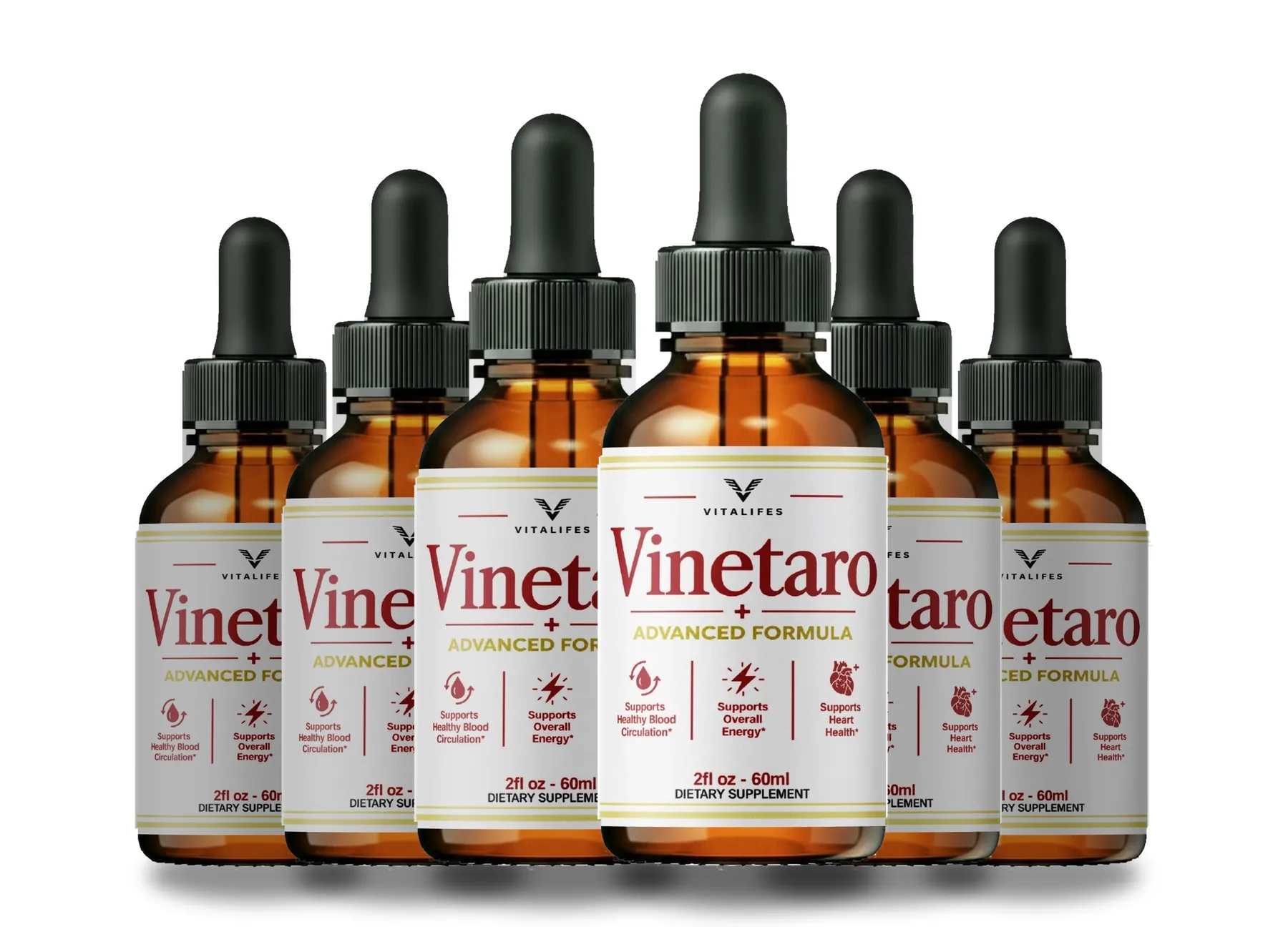
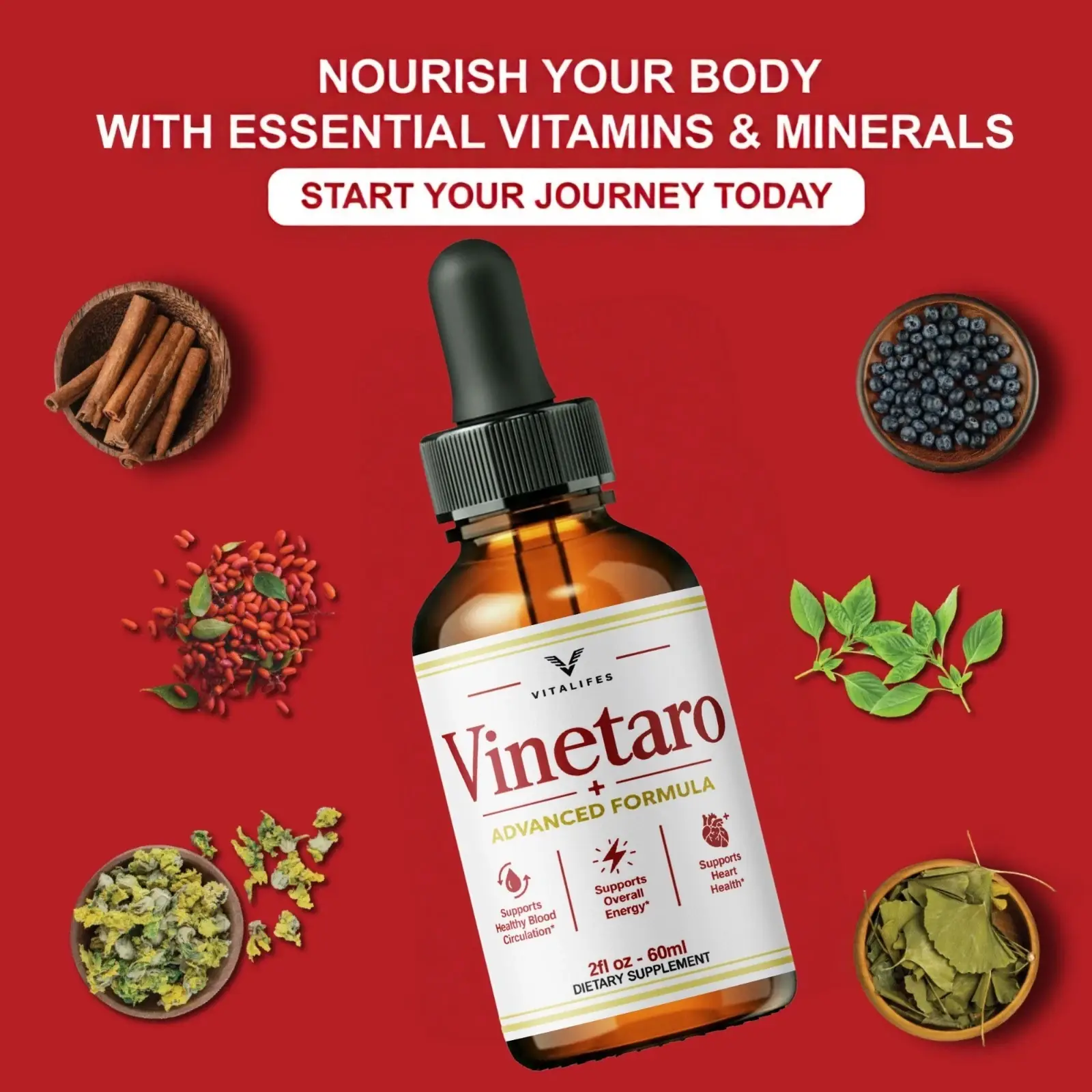
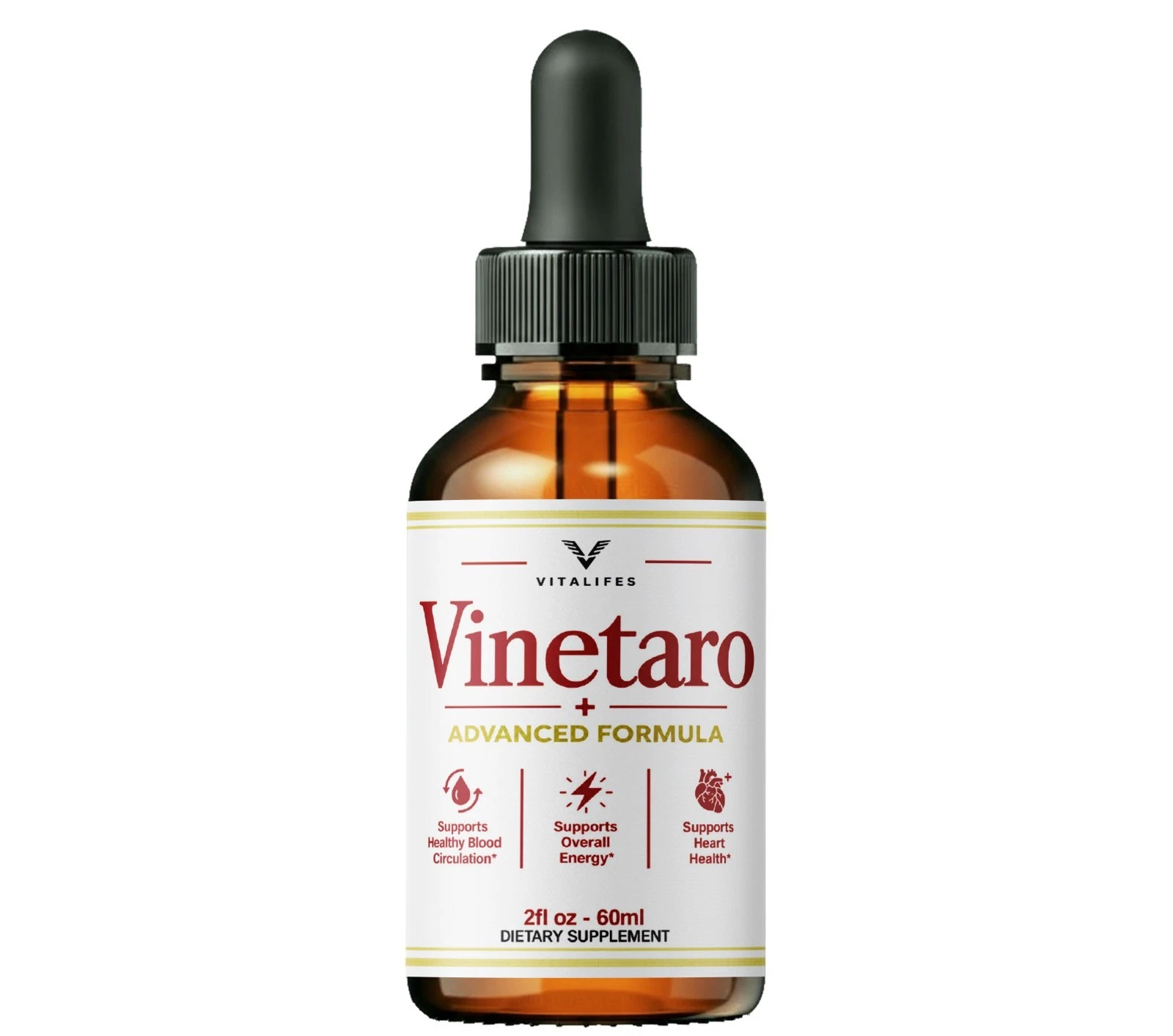
The ingredients page on this website sets out plainly what the Vinetaro Drops bottle prints on its front: a brand, a product name, a marketing line, three support phrases and a volume. No ingredient appears anywhere on that artwork, and no back-label photograph ships with this product. What does ship is a separate marketing panel, one of three square images supplied with the listing, arranging six plants around the bottle without a caption on any of them.
Ginkgo's fan-shaped leaves are the easiest of the six to name on sight, alongside cinnamon bark and a small heap of blueberries. That is a description of a photograph, not a declaration of contents, and this article treats it that way throughout: a picture of a plant beside a bottle is marketing, not a supplement panel, and no published trial result travels across a photograph. What a photograph of ginkgo can do, honestly, is prompt the right question — which is what the rest of this page is for.
Ginkgo's narrowest, best-tested use
Ginkgo biloba is one of the oldest living tree species and one of the most heavily researched botanicals in supplement science, with a human trial record stretching back decades. Most of that research clusters around one specific, narrow clinical question: does a standardised ginkgo leaf extract improve walking distance in people with intermittent claudication, the cramping calf or thigh pain caused by reduced blood flow to the legs during exercise, most often from peripheral artery disease?
That focus matters for reading the evidence honestly. Intermittent claudication is a diagnosed vascular condition with an objective, measurable outcome — how far a person can walk on a treadmill before pain forces a stop. It is a considerably narrower target than the general phrase “circulation,” and it is worth separating the two before looking at what the trials found, because a result in claudication does not automatically describe what happens to someone with no diagnosed vascular disease taking a supplement for a vaguer sense of wellness.
The Cochrane review: 14 trials, 739 people
A 2013 Cochrane systematic review pooled 14 randomised, placebo-controlled trials covering 739 people with intermittent claudication, comparing standardised ginkgo leaf extract against placebo on treadmill-measured walking distance. The review's conclusion is blunt: the trials, taken together, did not show a clinically meaningful or statistically reliable difference between ginkgo and placebo on how far participants could walk.
A systematic review of this kind does two things a single trial cannot. It searches for every trial that fits its question, published and unpublished, rather than only the ones that are easiest to find, which corrects for the tendency of positive results to get published more readily than negative ones. And it pools the data across trials rather than reporting one number from one study, which gives a more honest and more conservative picture of what the evidence, taken as a whole, actually supports.
| Field | What the Cochrane review reports |
|---|---|
| Trials pooled | 14 randomised, placebo-controlled trials |
| Participants | 739 people with intermittent claudication |
| What was measured | Treadmill-measured walking distance, pain-free and maximum |
| What was found | No reliable benefit over placebo |
| Population | People with a diagnosis of peripheral artery disease and claudication |
Fourteen trials and 739 people is a substantial evidence base for a botanical supplement. The size of the review is part of why its negative finding carries weight.
Why an earlier meta-analysis looked more favourable
An earlier meta-analysis, published in 2000, had reported a more favourable picture: pooling the trials available at the time, it found ginkgo associated with a modest but statistically significant improvement in pain-free walking distance compared with placebo. That earlier result is part of why ginkgo built the reputation it has in the circulation category in the first place.
The gap between the two reviews is not a contradiction so much as a demonstration of how evidence in this field tends to move. The 2000 analysis worked with fewer, generally smaller trials, some of which used less rigorous blinding and randomisation than later work. As the total trial count grew, and as later trials were run with larger samples and tighter methodology, the pooled effect shrank and eventually stopped clearing the bar for statistical reliability. That direction of travel — an encouraging early signal that narrows or disappears as the evidence base grows — is one of the most common patterns in supplement research, and it is worth knowing to recognise it elsewhere.
Neither review is wrong. The 2000 analysis accurately summarised the trials that existed in 2000. The 2013 review accurately summarised a larger, later body of evidence. The second is the more reliable answer to the question as it stands today, precisely because it had more data to work with, not because the earlier work was done badly.
The interaction question: bleeding risk and warfarin
Separate from whether ginkgo helps walking distance is a different question entirely: does it interact with medicines people are already taking? Here the literature is more consistent, and it is the part of this page worth reading even by someone with no interest in claudication at all.
A 2025 analysis looked specifically at ginkgo's drug interactions with a focus on bleeding risk and coagulation profiles, examining how ginkgo constituents affect platelet function and clotting pathways alongside prescription anticoagulant and antiplatelet medicines. A systematic review of warfarin interactions with food, herbal and dietary supplements separately identifies ginkgo among the botanicals with a documented interaction profile against warfarin specifically, a narrow-therapeutic-index blood thinner where small changes in effect can matter clinically.
| Source | What it examined | Relevant to |
|---|---|---|
| Mai et al., 2025 | Ginkgo's effect on bleeding risk and coagulation profiles | Anyone on an anticoagulant or antiplatelet medicine |
| Tan & Lee, 2021 | Systematic review of warfarin interactions with herbal and dietary supplements, ginkgo included | Anyone taking warfarin specifically |
Two independent lines of evidence point at the same mechanism: ginkgo and clotting. That consistency is exactly what makes an interaction flag worth taking seriously rather than dismissing as a single outlier finding.
Read what a photograph can and cannot tell you before deciding about Vinetaro Drops
Every research figure on this site carries the amount and the population its trial used, so the distance between a published result and any bottle stays visible rather than implied.
Price shown at the seller’s checkout · money-back satisfaction seal on the pack
Order Vinetaro Drops On The Official WebsiteTwo drops daily after a meal · 2 fl oz / 60 ml · lot VIN-26/TH-7868
What a photograph can and cannot tell a buyer
It is worth being precise about what has and has not been established on this page. Two things have: ginkgo's best-tested human use is walking distance in diagnosed claudication, and the trial evidence there does not currently support a reliable benefit; and ginkgo carries a documented interaction profile with blood-thinning medicines, backed by more than one independent source. Neither of those facts is in dispute.
What has not been established is anything at all about the bottle sold on this website. This label names no ingredient. A photograph on a marketing panel shows what a photograph shows: a recognisable leaf shape, arranged for visual effect, with no plant part stated, no extract standardisation given, and no amount printed anywhere. None of the research above can be attributed to this product, because attributing it would require information this label does not supply.
| The field | What the ginkgo trials supply | What this bottle supplies |
|---|---|---|
| The plant | Ginkgo biloba, named to species | Not named on the label |
| The preparation | Standardised leaf extract, typically EGb 761 or an equivalent standardisation in the pooled trials | Not stated |
| The amount | Varies by trial, but stated and standardised in each | Not printed anywhere on the artwork |
| The population studied | Adults with diagnosed intermittent claudication | Any adult who buys the bottle |
Every field the trials supply, this label leaves blank. That gap is the reason this article cannot say whether ginkgo, at any dose, is present in this bottle — and it is exactly why the interaction question below is worth raising with a prescriber rather than settling from a photograph.
Five questions worth asking before combining ginkgo with a prescription
An analysis of FDA supplement warnings is a useful reminder of why an undeclared label matters beyond the walking-distance question: where a product's printed contents cannot be checked, an interaction risk cannot be screened for either, by a pharmacist, a prescriber, or the buyer. That is the practical cost of a label with no ingredient list, and it applies to every plant on the marketing panel, not only the one with the clearest interaction literature.
- Is there a stated ingredient list at all, or only a photograph?
- If ginkgo (or any plant with a known interaction) is named, is there a milligram figure attached to it?
- Does the product carry a certificate of analysis that could confirm what a label claims?
- Has the prescribing clinician for the blood thinner been told about every supplement being taken, not only the ones that seem relevant?
- If the answer to any of the above is unclear, has the order desk been asked directly, in writing, before the next dose?
None of this proves the bottle sold on this website does or does not contain ginkgo at any dose. It cannot, because the label names no ingredient. What it does is set out, plainly, why the question is worth asking rather than assuming either answer — particularly for anyone on warfarin or another anticoagulant, where the published interaction literature is specific enough to be worth a phone call rather than a guess. The side effects page covers this and other interaction questions for the product more broadly.
References
- Nicolaï SP, Kruidenier LM, Bendermacher BL, et al. Ginkgo biloba for intermittent claudication. Cochrane Database Syst Rev. 2013;2013(6):CD006888. PMID 23744597. https://pubmed.ncbi.nlm.nih.gov/23744597/
- Pittler MH, Ernst E. Ginkgo biloba extract for the treatment of intermittent claudication: a meta-analysis of randomized trials. Am J Med. 2000;108(4):276-81. PMID 11014719. https://pubmed.ncbi.nlm.nih.gov/11014719/
- Mai NTQ, Hieu NV, Ngan TT, et al. Impact of Ginkgo biloba drug interactions on bleeding risk and coagulation profiles: A comprehensive analysis. PLoS One. 2025;20(4):e0321804. PMID 40198642. https://pubmed.ncbi.nlm.nih.gov/40198642/
- Tan CSS, Lee SWH. Warfarin and food, herbal or dietary supplement interactions: A systematic review. Br J Clin Pharmacol. 2021;87(2):352-374. PMID 32478963. https://pubmed.ncbi.nlm.nih.gov/32478963/
- Tucker J, Fischer T, Upjohn L, et al. Unapproved Pharmaceutical Ingredients Included in Dietary Supplements Associated With US Food and Drug Administration Warnings. JAMA Netw Open. 2018;1(6):e183337. PMID 30646238. https://pubmed.ncbi.nlm.nih.gov/30646238/