Vinetaro Drops Official Website › Blog › Beetroot Nitrate And Blood Pressure
Beetroot Nitrate And The Blood Pressure Number That Does Not Always Move
Dietary nitrate, delivered mainly through beetroot juice in the research literature, is one of the more mechanistically clear stories in circulation supplementation: nitrate converts to nitrite and then to nitric oxide, the same signalling molecule that relaxes blood vessels from the inside. A 2016 pooled analysis of twelve trials found a measurable improvement in vascular function. An 4-week trial published in 2024, in older adults with treated hypertension, found nothing at all on blood pressure or vascular function. Both results are real, and the honest question is what separates them.
- A 2016 systematic review and meta-analysis pooled 12 trials (246 participants) and found inorganic nitrate and beetroot supplementation improved endothelial function (SMD 0.36, 95% CI 0.16 to 0.56).
- That same analysis found the benefit was significantly associated with dose, and was smaller in older participants and those with greater cardiometabolic risk — a built-in caveat, not an outside criticism.
- A 2024 randomised, placebo-controlled crossover trial gave roughly 400 mg of nitrate a day for 4 weeks to adults aged 56 to 71 with treated hypertension, and found no difference in blood flow or blood pressure versus placebo.
- A 2023 dose-comparison pilot found a moderate nitrate dose moved blood pressure and endothelial function more than a higher dose did, which argues against a simple “more is better” reading.
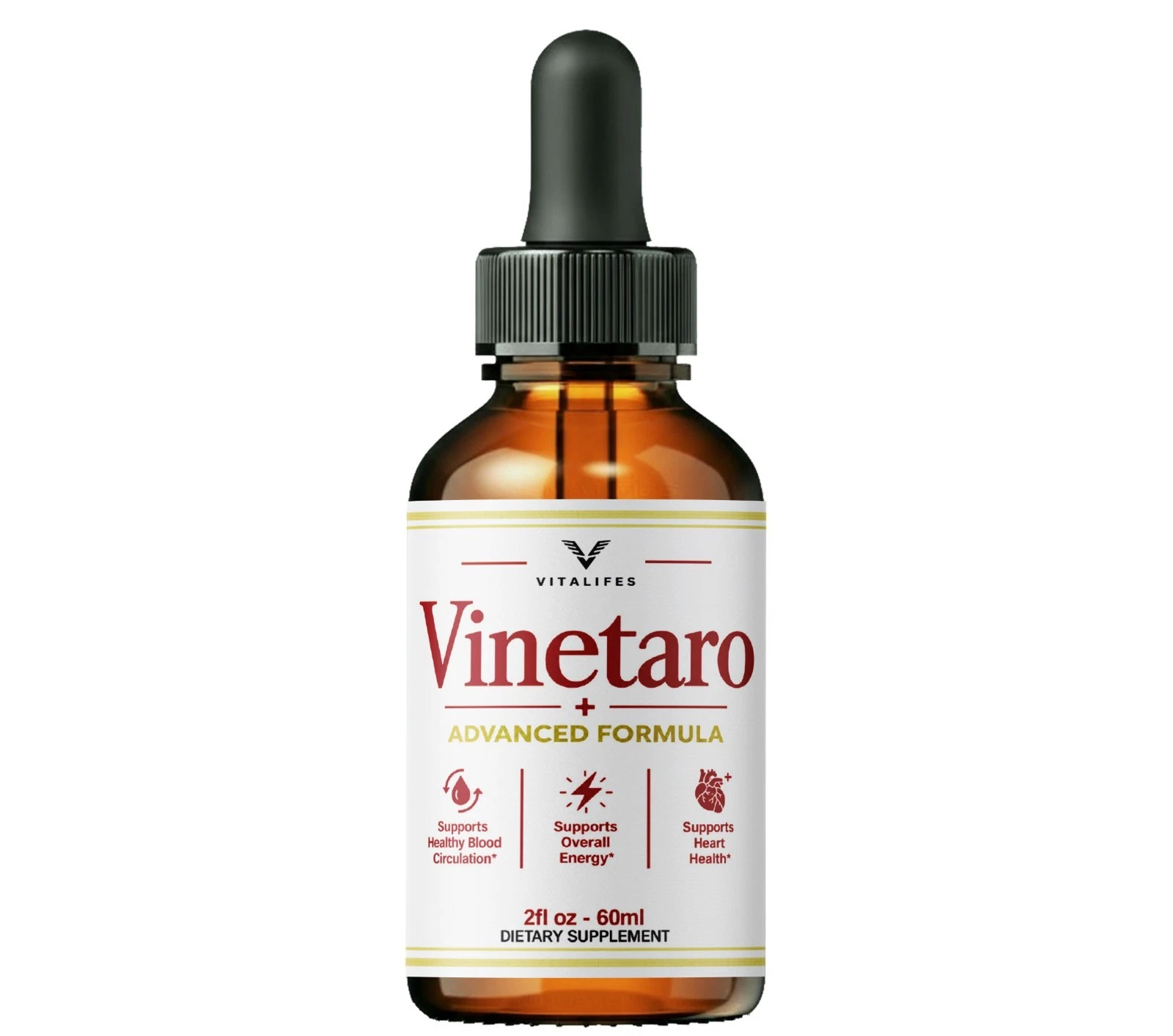
- None of this describes what is inside a Vinetaro Drops bottle. Its label names no ingredient, so there is no dose here to compare against any of these numbers.
Nitrate, nitrite, nitric oxide: the pathway in three steps
Dietary nitrate is abundant in leafy greens and root vegetables, and beetroot juice became the standard research vehicle for it mainly because it delivers a large, measurable dose in a small volume. Once swallowed, nitrate is partly converted to nitrite by bacteria on the tongue, then further converted to nitric oxide in the bloodstream and tissues under the right conditions, particularly low-oxygen environments such as an exercising muscle or a narrowed vessel.
Nitric oxide relaxes the smooth muscle lining blood vessels, which is the same signalling pathway several prescription vasodilators act on directly. That shared mechanism is why beetroot nitrate attracted serious research attention rather than folk-remedy status: there is a specific, testable biochemical story behind the claim, not just a plant with a reputation.
The 2016 pooled analysis: a real, modest effect
A 2016 systematic review and meta-analysis in the European Journal of Nutrition pooled nine crossover trials and three parallel trials, 246 participants in total, run between 2008 and 2014, with intervention lengths from 1.5 hours to 28 days. Inorganic nitrate and beetroot consumption were associated with an improvement in vascular function, a standardised mean difference of 0.36 (95% CI 0.16 to 0.56, p < 0.001).
A standardised mean difference of 0.36 is a small-to-moderate effect in the language researchers use for pooled analyses. It is a real, statistically defended signal, and it is not a dramatic one — a distinction worth holding onto before the next section, because the same paper explains part of why the signal is modest rather than large.
Why age and dose moved the result in the same paper
The 2016 analysis did not stop at a single pooled number. It also tested what predicted the size of the effect across the included trials, and found the improvement in endothelial function was significantly associated with the dose of nitrate given, and inversely associated with participant age and baseline cardiometabolic risk. In the authors' own words, the benefit “appear[s] to be reduced in older subjects and in subjects with greater cardiometabolic risk.”
That is an unusually candid result for a supplement-adjacent literature to publish about itself: the people most likely to be marketed a circulation supplement — older adults, people already carrying cardiometabolic risk — are the same group in whom this pooled analysis found the smallest average benefit.
This is not a case of one study contradicting another. It is the same analysis reporting both a positive average effect and the specific groups in whom that average effect shrinks. Reading only the headline number and skipping the moderator analysis would misrepresent the paper's own conclusion.
A 2024 trial that found nothing, and why that matters
A 2024 randomised, placebo-controlled crossover trial in Food & Function tested exactly the population the moderator analysis above flagged as least likely to respond: 15 adults aged 56 to 71 with treated hypertension. Participants received a single roughly 400 mg dose of nitrate, and then twice-daily roughly 400 mg doses for 4 weeks, through nitrate-rich versus nitrate-depleted beetroot juice.
Plasma and salivary nitrate and nitrite rose as expected, confirming the nitrate-nitrite-nitric oxide pathway was functioning in these participants. But there was no difference between nitrate and placebo in forearm blood flow response, and no difference in 24-hour ambulatory, home, or clinic blood pressure. The authors concluded the findings “do not support the hypothesis that an increased intake of dietary nitrate exerts sustained beneficial effects” in this population.
This is exactly the kind of result the 2016 moderator analysis predicted, arriving eight years later in a dedicated trial: take the pathway to the older, higher-risk group the pooled data already flagged as the weakest responders, and the effect that shows up in younger, healthier volunteers does not reliably appear.
A dose-comparison pilot: more nitrate, less effect
A 2023 pilot study ran a 13-week comparison of a moderate versus a high dietary nitrate dose and found the moderate dose produced greater effects on blood pressure and endothelial function than the higher dose did. That is a counter-intuitive result worth sitting with: within this literature, more nitrate has not reliably meant more benefit, and at least one trial found the opposite ordering.
A 2016 review in the same area summarised the broader endothelial-function and blood-pressure literature on dietary nitrate, and a 2023 acute crossover study in hypertensive patients measured central blood pressure and endothelial function after a single nitrate dose, adding to the picture that acute and chronic dosing do not necessarily behave the same way in this category.
Read what a result cost before deciding about Vinetaro Drops
Every research figure on this site carries the amount its trial used, so the distance between a published result and any bottle is visible rather than implied.
Price shown at the seller’s checkout · money-back satisfaction seal on the pack
Order Vinetaro Drops On The Official WebsiteTwo drops daily after a meal · 2 fl oz / 60 ml · lot VIN-26/TH-7868
A practical complication: beetroot juice is not a standardised dose
One detail rarely stated plainly in coverage of this research: unlike a capsule with a printed milligram figure, beetroot juice's nitrate content varies by beet variety, growing conditions, and processing. Trials in this literature typically report the nitrate dose in milligrams precisely because the juice itself is not a fixed unit — researchers measure and standardise it in the lab before dosing participants. A shopper drinking beetroot juice, or taking a beetroot-derived capsule with no nitrate content stated, cannot assume they are matching any of the doses discussed above, even if the ingredient name on the label matches.
One trial in people with type 2 diabetes
A 2013 trial in Free Radical Biology and Medicine tested dietary nitrate's effect on blood pressure, endothelial function and insulin sensitivity specifically in people with type 2 diabetes, a population that sits at the intersection of this site's circulation focus and the blood-sugar focus of some other products sold under adjacent names. It is included here for completeness rather than as a headline result, because a single trial in one clinical population is exactly the kind of evidence this site is built to avoid over-stating.
| Study | Who | Dose | Result |
|---|---|---|---|
| Lara et al., 2016 (pooled) | 246 participants, 12 trials, 2008–2014 | Varied by trial; effect rose with dose | Improved endothelial function overall (SMD 0.36); smaller in older, higher-risk subjects |
| Fejes et al., 2024 | 15 adults, 56–71, treated hypertension | ~400 mg/day for 4 weeks | No change in blood flow or blood pressure |
| Babateen et al., 2023 | Pilot, 13 weeks | Moderate vs. high nitrate dose | Moderate dose outperformed the higher dose |
Three studies, three different populations and durations, and not one consistent direction once age and dose are allowed to vary. That is what an honest reading of this literature looks like.
What transfers to a shelf bottle, and what does not
Dietary nitrate is one of the few compounds in this category where a negative, well-designed trial exists in the exact population most likely to buy a circulation supplement. That is worth more to a careful reader than another positive trial in young, healthy volunteers would be, because it addresses the question that actually matters commercially: does this work for the person reading the label, not for a 25-year-old research subject.
Vinetaro Drops names no ingredient, so nothing above can be checked against this bottle specifically. What the beetroot literature offers instead is a template for the right question to ask of any circulation product claiming a nitrate or vascular-function benefit: what was the dose, in whom, for how long, and did the trial run in someone who looks like you rather than someone who does not.
References
- Lara J, Ashor AW, Oggioni C, Ahluwalia A, Mathers JC, Siervo M. Effects of inorganic nitrate and beetroot supplementation on endothelial function: a systematic review and meta-analysis. Eur J Nutr. 2016;55(2):451-459. PMID 25764393. https://pubmed.ncbi.nlm.nih.gov/25764393/
- Fejes R, Lutnik M, Weisshaar S, et al. Increased nitrate intake from beetroot juice over 4 weeks affects nitrate metabolism, but not vascular function or blood pressure in older adults with hypertension. Food Funct. 2024;15(8):4065-4078. PMID 38546454. https://pubmed.ncbi.nlm.nih.gov/38546454/
- Babateen AM, Shannon OM, O'Brien GM, et al. Moderate doses of dietary nitrate elicit greater effects on blood pressure and endothelial function than a high dose: A 13-week pilot study. Nutr Metab Cardiovasc Dis. 2023;33(6):1263-1267. PMID 36958967. https://pubmed.ncbi.nlm.nih.gov/36958967/
- d'El-Rei J, Cunha AR, Trindade M, Neves MF. Beneficial Effects of Dietary Nitrate on Endothelial Function and Blood Pressure Levels. Int J Hypertens. 2016;2016:6791519. PMID 27088010. https://pubmed.ncbi.nlm.nih.gov/27088010/
- Mattos S, Cunha MR, Marques BC, et al. Acute Effects of Dietary Nitrate on Central Pressure and Endothelial Function in Hypertensive Patients: A Randomized, Placebo-Controlled Crossover Study. Arq Bras Cardiol. 2023;120(1):e20220209. PMID 36629601. https://pubmed.ncbi.nlm.nih.gov/36629601/
- Gilchrist M, Winyard PG, Aizawa K, Anning C, Shore A, Benjamin N. Effect of dietary nitrate on blood pressure, endothelial function, and insulin sensitivity in type 2 diabetes. Free Radic Biol Med. 2013;60:89-97. PMID 23395779. https://pubmed.ncbi.nlm.nih.gov/23395779/