Vinetaro Drops Official Website › Blog › Blueberries At 302 Milligrams Of Anthocyanins
Blueberries At 302 Milligrams Of Anthocyanins: The Dose Behind The Photograph
Of the six plants photographed on the seller's own marketing panel, blueberry is the one whose circulation evidence comes with a number worth holding on to. Two well-designed human trials gave it at food-scale quantities — not milligrams, but grams, and in one case a fraction of a cup. Setting that quantity beside a two-drop dose is the most useful thing this article can do.
- A double-blind, placebo-controlled trial gave healthy older adults 26 g of freeze-dried wild blueberry powder a day, supplying 302 mg of anthocyanins, and measured vascular function against placebo.
- A separate six-month trial in people with metabolic syndrome ran at 75 g and 150 g of freeze-dried equivalent a day — roughly half a cup and a full cup of blueberries.
- Twenty-six grams of powder is a heaped tablespoon. These are food quantities, not supplement quantities.
- This bottle names no ingredient, so none of the above can be attributed to it — but the photograph is the reason the comparison is worth making explicit.
- No dropper bottle, at two drops a day, reaches a gram-scale daily quantity of anything.
The photograph, and the one plant with a real number
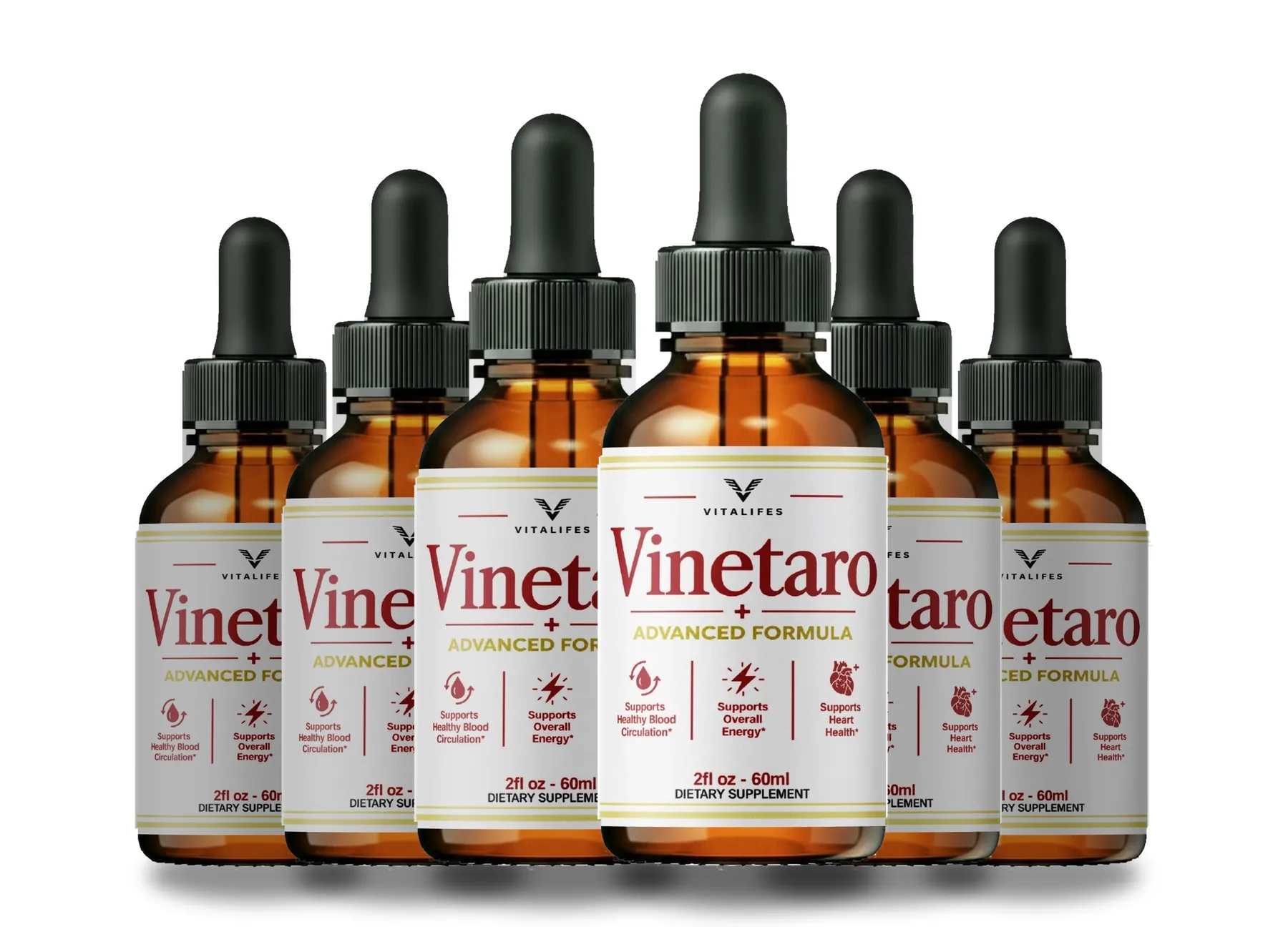
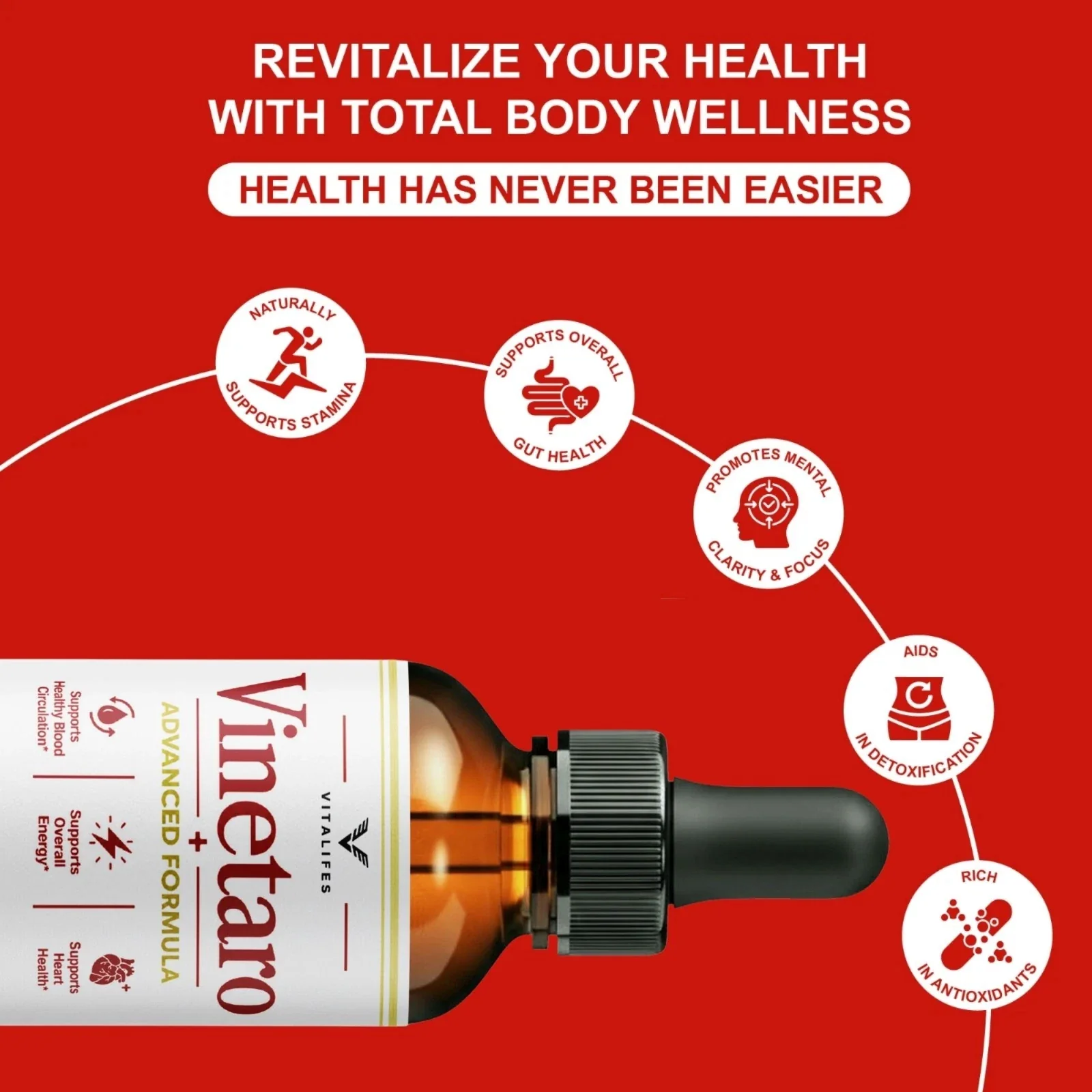
The Vinetaro Drops bottle sold on this website prints a brand, a product name, a marketing line, three support phrases and a volume on its front label. Nothing on that artwork names an ingredient, and no back-label photograph ships with the product, a gap covered in full on the ingredients page. What does ship is a separate marketing panel arranging six plants around the bottle, none of them captioned.
Cinnamon bark, blueberries, a small unidentified red berry, a green leafy herb, dried yellow flowers and fan-shaped ginkgo leaves are what a careful look at that panel shows. Of those six, blueberry stands out for one reason that has nothing to do with the photograph itself: it is the one item whose relevant human research states an amount precise enough to compare against anything, down to the milligram of active compound. That makes it worth reading closely, on its own terms, separate from any claim about what this bottle contains.
What anthocyanins are, and why blueberries are studied for them
Anthocyanins are the pigments responsible for the deep blue-purple colour of blueberries, blackberries, purple grapes and a wide range of other fruits and vegetables. They belong to the larger polyphenol family, and blueberries are among the most concentrated ordinary dietary sources of them. Anthocyanins are one of the most heavily studied classes of dietary polyphenol for cardiovascular and cognitive outcomes, with mechanisms proposed around improved endothelial function — the health of the thin layer of cells lining blood vessels — and antioxidant activity, though as with most polyphenol research the human clinical outcomes are the more solid evidence than the proposed mechanisms behind them.
Because the active compound class is identifiable and measurable, blueberry trials in this area tend to report a milligram figure for anthocyanin content alongside a gram figure for the whole-food or powder dose, which is unusual rigor for a food-based intervention and part of why the two trials below are worth reading in full rather than summarising as “blueberries help circulation.”
The 2023 vascular function trial: 26 g, 302 mg
A 2023 double-blind, randomised, placebo-controlled trial gave healthy older adults 26 g of freeze-dried wild blueberry powder a day, standardised to supply 302 mg of anthocyanins, and measured vascular function and cognitive performance against a matched placebo powder. Wild blueberries were chosen specifically for their higher anthocyanin density compared with cultivated varieties, which is part of why the trial could reach 302 mg of the active compound class from a modest 26 g of powder.
Twenty-six grams of powder is, in practical terms, a heaped tablespoon — a quantity a person could reasonably stir into a smoothie or yoghurt each morning, but a quantity that bears no resemblance to a dropper serving of anything. The trial ran in healthy older adults specifically, a population chosen because vascular and cognitive decline are more measurable, and more clinically relevant, in that age group than in younger healthy adults.
The 2019 metabolic syndrome trial: 75 to 150 g
A separate six-month, double-blind, randomised controlled trial ran in participants with metabolic syndrome, a cluster of risk factors including elevated blood pressure, blood sugar and abdominal fat that raises cardiovascular risk. This trial used a considerably larger daily dose: 75 g and 150 g of freeze-dried blueberry equivalent a day, tested against each other and against a lower-dose or placebo comparison, and measured biomarkers of cardiometabolic function over the full six months.
Seventy-five grams of freeze-dried equivalent works out to roughly half a cup of fresh blueberries by weight; 150 g is roughly a full cup, eaten daily, for six months straight. These are unambiguously food quantities. Nobody designing this trial was testing whether a trace amount of blueberry extract does something measurable; they were testing whether eating blueberries, at a serving size a person could actually sustain in real life, moves biomarkers that matter for cardiovascular risk over a meaningful stretch of time.
| Trial | Who | Dose | Duration |
|---|---|---|---|
| Wood et al., 2023 | Healthy older adults | 26 g wild blueberry powder/day, 302 mg anthocyanins | Single-session and short-term measures |
| Curtis et al., 2019 | Adults with metabolic syndrome | 75 g and 150 g freeze-dried equivalent/day | 6 months |
One trial states a precise anthocyanin figure; the other states only the whole-food equivalent. Both are gram-scale, food-sized doses, sustained daily.
Read the dose behind the photograph before deciding about Vinetaro Drops
Every research figure on this site carries the amount and the population its trial used, so a food-scale dose and a dropper-scale serving are never quietly conflated.
Price shown at the seller’s checkout · money-back satisfaction seal on the pack
Order Vinetaro Drops On The Official WebsiteTwo drops daily after a meal · 2 fl oz / 60 ml · lot VIN-26/TH-7868
Reading a food-scale dose against a dropper
The dropper arithmetic article on this blog works through what two drops actually amounts to: roughly a tenth of a millilitre, out of a 60 ml bottle. That is a volume, not a weight, so it cannot be compared directly to a gram figure for blueberry powder without a step in between — but the scale gap is informative even before doing that arithmetic precisely.
Twenty-six grams is twenty-six thousand milligrams. Even allowing for the fact that a concentrated liquid extract can pack more activity per gram than a whole-food powder, the distance between a milligram-scale ingredient inside a few drops of liquid and a tablespoon-to-cupful of blueberry eaten daily is not a rounding difference. It is the kind of gap that separates a food-based clinical intervention from a decorative amount of something in a formula.
- 26 g of powder a day is roughly a heaped tablespoon, taken daily for the length of a trial.
- 75 to 150 g of freeze-dried equivalent a day is roughly half a cup to a full cup of blueberries.
- A two-drop dropper serving is on the order of a tenth of a millilitre of liquid, by volume.
- No published trial in this specific evidence base used a milligram-scale extract dose delivered by dropper.
What transfers to this bottle, and what does not
Nothing in the two trials above can be attributed to the bottle sold on this website. The label names no ingredient, states no plant part, gives no extract ratio and prints no amount. Blueberry appearing in a marketing photograph establishes only that a photograph of blueberries was chosen for the artwork — a decision made by whoever designed the panel, for reasons of visual appeal rather than disclosure.
| The field | What the blueberry trials supply | What this bottle supplies |
|---|---|---|
| The plant | Wild or cultivated blueberry, named to genus | Not named on the label |
| The preparation | Freeze-dried powder, standardised for anthocyanin content in one trial | Not stated |
| The amount | 26 to 150 g a day, depending on the trial | Not printed anywhere on the artwork |
| The duration | Up to six months, daily | Not applicable, since no dose is stated |
Every field the trials supply, this label leaves blank. An analysis of FDA supplement warnings is a useful reminder of why that gap matters: where a label cannot be checked against a dose, a buyer has a photograph and a trust decision, not a specification.
What this article can say honestly is narrower and more useful than a claim either way: if a reader is drawn to this product because blueberries are pictured on its marketing panel, the research those blueberries would need to earn that association used a spoonful to a cupful a day, sustained for weeks or months — a scale no dropper bottle, described as two drops daily, is built to deliver.
A note on eating blueberries anyway
None of the above is an argument against blueberries as food. A cup of blueberries a day is a realistic, low-risk habit with a genuine evidence base behind it, and it does not require trusting an unlabelled bottle to get there. The distinction this article draws is narrower and more specific: a photograph of a fruit on a supplement carton is not the same claim as a stated dose on a Supplement Facts panel, and only the second kind of claim can be checked against the research above.
Anyone comparing supplements on the strength of a blueberry photograph is better served reading the actual serving size, if one is printed, and converting it to grams before assuming any circulation or vascular benefit applies. A capsule or dropper product that states, say, “100 mg blueberry extract” is offering roughly a two-hundred-and- sixtieth of the whole-food quantity used in the 2019 trial's lower arm, before accounting for the fact that an extract ratio is rarely disclosed either. The arithmetic is the same whether it is done for this bottle or for a competitor's.
References
- Wood E, Hein S, Mesnage R, Fernandes F, Abhayaratne N, Xu Y, Zhang Z, Rodriguez-Mateos A. Wild blueberry (poly)phenols can improve vascular function and cognitive performance in healthy older individuals: a double-blind randomized controlled trial. Am J Clin Nutr. 2023;117(6):1306-1319. PMID 36972800. https://pubmed.ncbi.nlm.nih.gov/36972800/
- Curtis PJ, van der Velpen V, Berends L, Jennings A, Feelisch M, Umpleby AM, Evans M, Fernandez BO, Meiss MS, Minnion M, Potter J, Minihane AM, Kay CD, Rimm EB, Cassidy A. Blueberries improve biomarkers of cardiometabolic function in participants with metabolic syndrome-results from a 6-month, double-blind, randomized controlled trial. Am J Clin Nutr. 2019;109(6):1535-1545. PMID 31136659. https://pubmed.ncbi.nlm.nih.gov/31136659/
- Tucker J, Fischer T, Upjohn L, et al. Unapproved Pharmaceutical Ingredients Included in Dietary Supplements Associated With US Food and Drug Administration Warnings. JAMA Netw Open. 2018;1(6):e183337. PMID 30646238. https://pubmed.ncbi.nlm.nih.gov/30646238/